Adaptive Sea State Estimation Based on Ship Motions in Semi-stationary Sea States
Environmental information is critical for ensuring the safety of complex marine operations (e.g., offshore crane operations and dynamic positioning), with waves being the primary external force affecting floating structures. Accurate sea state estimation (SSE) not only significantly enhances operational efficiency but also serves as vital support for real-time decision-making and risk control. The wave buoy analogy (WBA) utilizes ship motion data to estimate wave energy distribution; due to its cost-effectiveness, flexibility, and lack of need for additional sensing equipment, it has gradually become one of the most important real-time monitoring methods in the field of ocean engineering.
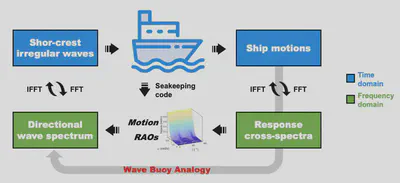
Traditional WBA methods are typically established upon the stationary assumption, often employing fixed 30-minute manual segmentation for long-term observations. However, the actual marine environment exhibits significant non-stationary and time-involved characteristics, and simplifying them as stationary can introduce inaccuracies and uncertainties during the evolutionary process. Especially in wave spectrum resolution, which is a highly sensitive and ill-posed inverse problem, minor biases in response spectra can be amplified, leading to misleading estimates and affecting the reliability of engineering decisions.
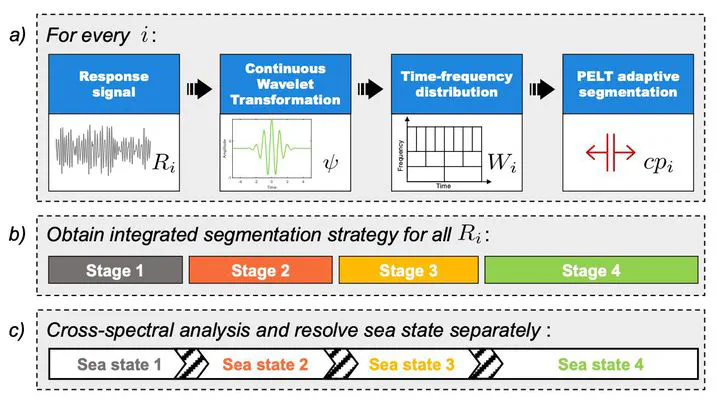
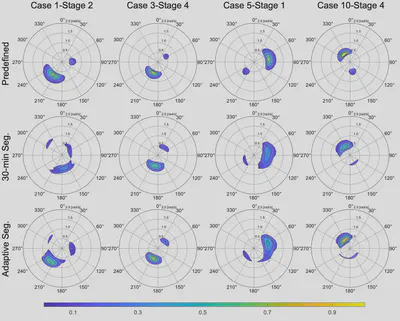
To address these challenges, this study proposes a wavelet-based adaptive segmentation algorithm for the real-time monitoring of semi-stationary sea states. First, an evolutionary sea state model with continuously drifting parameters is constructed, utilizing random changepoints and linear interpolation to describe the continuous, non-discrete time-varying nature of real-world sea areas. Subsequently, the continuous wavelet transform (CWT) is introduced to replace the traditional short-time Fourier transform (STFT), leveraging its frequency-adaptive time-frequency window to ensure high frequency resolution for low-frequency components while enhancing time resolution for high-frequency components, thereby improving the analytical capability for the sea state evolution process. Based on this, the pruned exact linear time (PELT) algorithm is integrated to automatically detect and segment changepoints in multi-DoF ship motion responses (Heave, Roll, and Pitch) by minimizing a cost function and penalty terms.
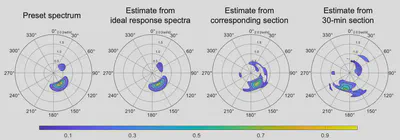
Numerical simulation results demonstrate that the proposed method can accurately identify the evolutionary stages of sea states. Across 40 typical cases, the adaptive segmentation strategy significantly outperforms the traditional fixed 30-minute segmentation method in terms of mean square error (MSE). These findings provide an effective signal processing approach and theoretical foundation for enhancing the robustness of WBA in real-time sea state monitoring and engineering applications.
The research result titled “Estimating Semi-stationary Sea States through Wavelet-based Adaptive Segmentation of Ship Motions” is published in Ocean Engineering. The first author is Taiyu Zhang, a doctoral student at the Shenzhen International Graduate School, Tsinghua University, and the corresponding author is Associate Professor Zhengru Ren of Shanghai Jiao Tong University.
Paper Link: https://doi.org/10.1016/j.oceaneng.2025.124030